Last verified: November 2026. This guide is general information, not engineering or legal advice.
Repair a seawall when the damage is localized and the wall still has years of life left. Replace it when the failure is structural, when the wall is near the end of its service life, or when local rules require a higher wall anyway. Most owners don't face that decision during a disaster. After Hurricane Ian, Punta Gorda faced a city-wide seawall repair job that city officials said could take up to 18 months. Thousands of 5,000-pound concrete panels cracked or broke when canals drained ahead of the storm and saturated soil pushed on walls with no water on the other side (WGCU, May 2023). More often, the decision arrives as an inspection report or a contractor's quote.
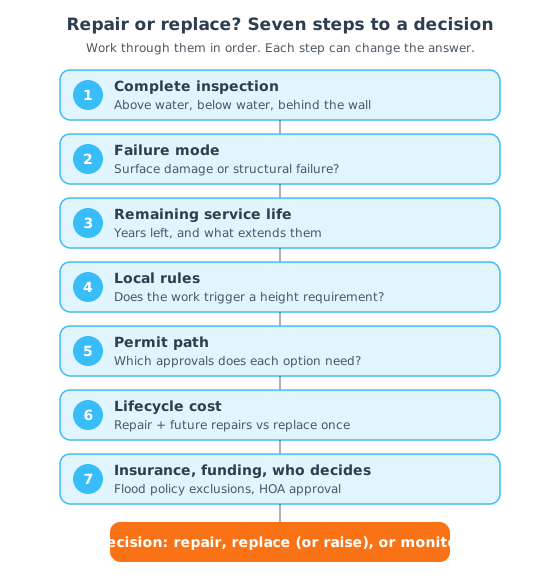
That's where it gets hard. Many contractors sell one answer, quotes for the same wall can differ widely, and several different "50% rules" get repeated without context. This guide gives you a 7-step way to reach a decision you can defend, plus the questions to ask before you sign anything. It's vendor-neutral and built on municipal engineering practice, state law and Sea Grant guidance.
Key Takeaways
- Repair usually makes sense for localized damage (cracks, spalls, failed joints, small soil voids) on a wall with remaining life.
- Replacement comes into play when the failure is structural (failed tiebacks causing lean, scour undermining the toe, widespread corrosion), when the wall is near the end of its life, or when local rules require a higher wall. NC Sea Grant puts bulkhead life expectancy at about 25 years, depending on composition and location.
- There are several different "50% rules." FEMA's applies to buildings, not seawalls. Local codes such as Broward County's use their own test. "Replace if repair costs more than half" is a contractor rule of thumb, not a law.
- Decide on remaining life and lifecycle cost, not the lowest first quote, and base the decision on a written assessment from a licensed professional.
If you haven't had an inspection yet, start with our complete seawall inspection guide. For the bigger picture on methods, costs and permits, see our seawall repair and replacement guide.
The Short Answer: When Repair Works and When It Doesn't
The type of damage matters more than how much of it you can see. Surface problems on a healthy wall are repair jobs. Problems with the parts that hold the wall up, such as the tiebacks, the anchors behind the wall and the embedment at its base, call for an engineer, and often a new wall.
Use this table as a set of tendencies, not rules:
| What you see | Leans repair | Leans replace | Get an engineer |
|---|---|---|---|
| Cap cracks or spalled (flaking) concrete | ✔ | ||
| Failed joints, clogged weep holes | ✔ | ||
| Small, isolated soil void behind the wall | ✔ | ||
| Lean, bowing or a wavy top line | ✔ Possible tieback or anchor failure | ||
| Scour at the toe, loss of embedment | ✔ | ||
| Widespread corrosion or section loss | ✔ | ✔ | |
| Wall near or past its expected service life | ✔ | ||
| Below the local minimum height, with major work planned | ✔ (or raise it) | ✔ |
The steps below explain each row and add the factors a table can't show: permits, cost over time, insurance and who gets a say.
Step 1: Make Sure You're Deciding on a Complete Inspection
You can't choose between repair and replacement based on half the wall. A useful inspection looks at three zones: above the water, below the water, and the soil behind the wall. Many failures start underwater or underground. A standard home inspection usually stops at what's visible from land and doesn't judge structural adequacy, so it isn't enough for this decision.
Ask for two things beyond a list of defects.
Condition ratings by component. Fort Lauderdale's Seawall Master Plan, written by engineers for the city's own walls, rates each component on a 1-to-4 scale modeled on the National Bridge Inspection Standards, with 1 the best condition (City of Fort Lauderdale Seawall Master Plan, 2018). Ratings make two contractors' opinions comparable.
A remaining-life estimate with a timeline. The same plan groups its recommendations into 5-year windows (0–5, 6–10, 11–15 and 16–20 years). That framing works for a homeowner too. "Repair the cap now, expect tieback work in 6–10 years" is far more useful than "the wall has some cracks."
Who should inspect your seawall depends on the decision. For repair-or-replace, a marine contractor can scope repairs, but a professional engineer should evaluate any structural concern.
Step 2: Identify the Failure Mode
A wall with ugly surface damage can be sound, and a wall that looks fine can be failing below the mudline. Sort what the inspection found into two groups.
Localized damage (usually repairable):
- spalls and cracks in the cap or panels (cracks are often sealed with epoxy injection)
- failed joints between panels, where soil can leak through
- clogged weep holes (the openings that let water drain out from behind the wall)
- small soil voids behind the wall
- a deteriorating cap
Structural failure (needs an engineer):
- Tieback or anchor failure. Tiebacks are rods that connect the wall to an anchor buried in the yard, called a deadman. When they fail, the wall leans, bows or develops a wavy top line.
- Toe scour and loss of embedment. Moving water removes the bottom from in front of the wall's base, so fill escapes underneath and the wall loses the soil that holds its base in place.
- Widespread corrosion of steel sheets or the steel reinforcing inside concrete.
- Rotation of the wall as a whole.
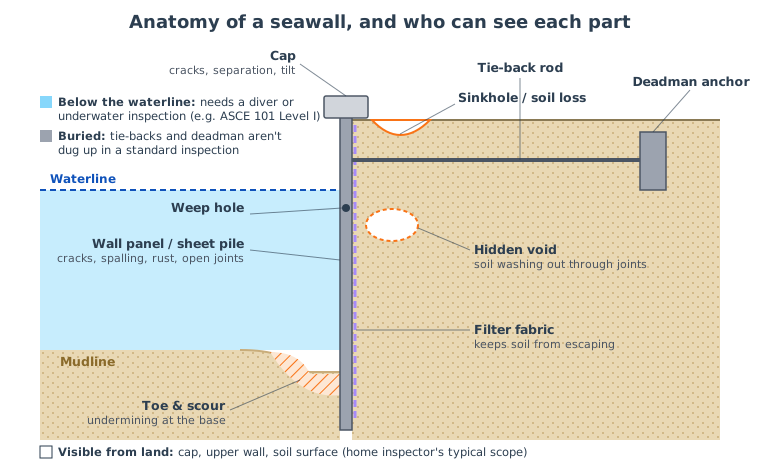
North Carolina Sea Grant lists the warning signs owners can check themselves: holes or divots near the wall, which can signal failure below ground; new leaning, bowing or wobbling; severe rust; missing pieces; scour at the ends; and water overtopping the wall. Check lean with a level, or a level app on your phone, and photograph the wall from several angles so you can compare over time (NC Sea Grant, Coastwatch, 2024).
Water pressure can also cause failure. That's what happened in Punta Gorda: when water drains from the front of a wall while the soil behind it is saturated, the wall has to hold back the weight of wet soil with nothing pushing back. Working weep holes reduce that risk.
For more on what individual symptoms mean, see the warning signs section of our seawall repair and replacement guide.
Step 3: Estimate Remaining Service Life
Remaining life is the pivot of the whole decision. A wall with decades left is worth repairing, even at real cost. A wall near the end of its life usually isn't, because you'll pay for repairs and then for a new wall anyway.
North Carolina Sea Grant puts bulkhead life expectancy at "about 25 years, depending on their composition and location" (NC Sea Grant, 2024). Treat that as a rough benchmark, not a deadline. Some walls fail sooner and some last longer.
The Fort Lauderdale plan bases remaining life on:
- when the wall was built
- its current condition
- how the property behind it is used
- how exposed it is to waves and weather
- whether life-extending measures have been applied
Life-extending measures include repairs, cathodic protection (a system that slows corrosion of the steel inside concrete), concrete jacketing and scour protection at the toe. Ask your engineer which of those apply to your wall and how many years each would add.
You'll see confident lifespans by material on contractor and vendor sites. We haven't found an independent source for those figures, so we don't repeat them. Material does matter, and our upcoming guide to seawall materials will cover how each one ages.
The three "50% rules," untangled
You'll hear that a seawall "must be replaced" once damage passes 50 percent. Several different rules use that number, and none of them is a universal test for private seawalls:
- FEMA's substantial damage and improvement rule applies to buildings. FEMA defines a "structure" for this rule as "a walled and roofed building" (plus gas or liquid storage tanks and manufactured homes), and the threshold is 50 percent of the building's market value (44 CFR 59.1). It doesn't govern seawalls, though it can matter for your house after a major storm.
- FEMA's Public Assistance rule treats a damaged facility as repairable when repair costs less than 50 percent of replacement (44 CFR 206.226). It applies to public applicants such as cities, not to homeowners.
- Local seawall codes set their own tests. In Broward County, Florida, repairs to more than 50 percent of a property's seawall count as "substantial repair," which brings the wall under the county's minimum height requirement (Broward County Code, Ch. 39, Art. XXV).
"Replace if repairs cost more than half of a new wall" is a contractor rule of thumb. It can be a reasonable starting point for a conversation, but no code we've found requires it.
Step 4: Check Whether Local Rules Will Force the Decision
In some places, a big enough repair legally becomes "substantial repair," and the wall then has to meet current height rules. When that happens, raising the cap or replacing the wall may be the practical choice, whatever the condition of the old one.
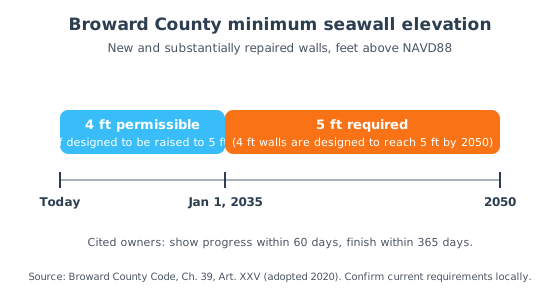
Broward County, Florida. The county's tidal flood barrier rules, adopted in 2020, set a minimum elevation of 5 feet NAVD88 for new and substantially repaired walls. (NAVD88 is the national reference datum surveyors use to measure elevation.) Until January 1, 2035, a wall may be permitted at 4 feet if it's designed so it can be raised to 5 feet by 2050. Owners cited for tidal flooding through or over their wall have deadlines. They must show progress within 60 days and finish within 365 days (The Invading Sea, April 2020; Broward County Code, Ch. 39, Art. XXV).
Fort Lauderdale. The city amended its seawall ordinance in 2023 to set a 5-foot minimum top elevation for new seawalls (City of Fort Lauderdale; Waterfront Times, April 2023). The earlier standard was 3.9 feet NAVD88 (Fort Lauderdale Seawall Master Plan, 2018).
Everywhere else. Many cities and counties have no seawall height rule at all, and others are adding them. Ask your local building department two questions before you choose: is there a minimum seawall elevation, and what amount of repair triggers it?
Step 5: Understand the Permit Path for Each Option
Repairs and replacements in the same place often have simpler permit paths than new or relocated walls. "Often" isn't "always," and the details decide which option is faster and cheaper to permit.
Florida. State law exempts "restoration of seawalls at their previous locations or upland of, or within 18 inches waterward of, their previous locations" from state environmental permitting (Fla. Stat. § 403.813(1)(e)). The exemption is narrower than many contractor sites suggest. The rule that implements it applies when the wall was damaged or destroyed by a discrete event within the past year, or when the work involves only minimal backfilling and isn't primarily meant to reclaim land (F.A.C. 62-330.051(12)(b)). A planned replacement of an aging wall may not qualify. Coastal construction permits under Chapter 161 still apply. Using state-owned submerged land needs separate authorization. Work outside the exemption goes through a general permit or an individual Environmental Resource Permit.
Other states draw the line differently. In Connecticut, for example, an in-kind, in-place replacement can use a general permit, while changing the wall's size or location requires an individual permit (UConn / Connecticut Sea Grant).
Federal permits. The U.S. Army Corps of Engineers may also need to authorize the work. Two of the 2026 Nationwide Permits are most relevant (Federal Register, January 2026):
- NWP 3 covers the repair, rehabilitation or replacement of a "previously authorized, currently serviceable" structure, with minor deviations allowed.
- NWP 13 covers bank stabilization, with limits on length and fill that can be waived through a pre-construction notification.
Your Corps district may also have regional permits that apply instead.
Ask each contractor which permits their proposed scope needs, who will pull them, and how long they expect approval to take.
Step 6: Compare Lifecycle Cost, Not the First Quote
The cheaper option today can cost more over 10 to 20 years if repairs keep coming back on a wall near the end of its life. Compare the two paths over the same period:
- Ask each contractor for three things: the scope, how many years of life the work should add, and what repairs will likely come next.
- Compare "repair now plus likely future repairs" with "replace once." Use the same time span for both.
- Add the costs that aren't in the construction quote: engineering, surveys, permits and any code-driven upgrades such as a higher cap.
How replacement is done matters for cost and permits. Fort Lauderdale's plan describes installing a new sheet-pile or panel wall immediately in front of the existing one, leaving the old wall in place. That's one reason Florida's 18-inch allowance matters: it can let a new wall go in front of the old one under the restoration exemption, if the rule's conditions are met. For the options on the repair side, see the repair methods section of our seawall repair and replacement guide.
We don't quote dollar figures here, because seawall prices vary widely by region, wall type, access and engineering. Our seawall replacement cost guide (publishing November 16) explains the ranges and why quotes differ. When you collect bids, make sure each contractor prices the same scope.
Step 7: Factor In Insurance, Funding and Who Decides
Standard federal flood insurance won't pay for the wall itself. The NFIP's Standard Flood Insurance Policy excludes "fences, retaining walls, seawalls, bulkheads, wharves, piers, bridges, and docks" (44 CFR Part 61, Appendix A(1)). If you have private flood or homeowners coverage, read the policy terms for seawalls specifically before assuming either way.
Public funding is for public walls. After major disasters, federal and state programs may help pay for city-owned seawalls. Private owners generally shouldn't count on that money.
HOAs and condominiums face the same decision with shared money and more people involved. A few practices help boards:
- Read the governing documents to confirm who owns the wall and who pays.
- Get a second engineering opinion before committing reserves or a special assessment.
- Send one written scope to every bidder so the quotes are comparable.
- Document the decision and the reasoning for owners.
Frequently Asked Questions
What is the 50% rule for seawalls?
There isn't a single one. FEMA's 50 percent rule applies to buildings, not seawalls. FEMA's Public Assistance rule applies to public facilities. Some local codes, such as Broward County's, define "substantial repair" by their own 50 percent test, which can trigger height requirements. "Replace if repair costs more than half" is a contractor rule of thumb. See the callout above for details.
How long does a seawall last?
NC Sea Grant puts bulkhead life expectancy at about 25 years, depending on composition and location. Actual life varies with material, exposure and maintenance, so ask your engineer for a remaining-life estimate for your wall.
Do I need a permit to repair a seawall in Florida?
Possibly not from the state, if the work fits the restoration exemption in § 403.813(1)(e) and its conditions. You may still need local building permits, coastal permits under Chapter 161, authorization for state-owned submerged lands, or federal approval. Confirm with the Florida Department of Environmental Protection and your local building department.
Will insurance pay for my seawall?
Not under a standard NFIP flood policy, which excludes seawalls and bulkheads. Check any private policy's terms.
The Bottom Line
- Base the decision on a complete inspection with condition ratings and a remaining-life estimate.
- Separate surface damage from structural failure. Lean, scour and widespread corrosion need an engineer.
- Remaining life drives the decision. Bulkheads average about 25 years, per NC Sea Grant.
- Check local height rules and the permit path for each option before you choose.
- Compare lifecycle cost over the same time span, not just the first quote.
- Don't count on flood insurance to pay for the wall.
Get at least three quotes for the same written scope from licensed marine contractors. Find seawall contractors near you, and work through our seawall contractor checklist before you sign.
This guide is general information, not engineering or legal advice. For structural decisions, consult a licensed professional engineer and follow your local building department's requirements.