Last verified: November 2026. This guide is general information, not engineering or legal advice.
Most seawall problems start small: a cracked cap, an open joint, a clogged weep hole, or soil leaking through the wall and leaving a hole in the yard. Caught early, most of them can be repaired. Left alone, they can become the kind of failure that needs a new wall. After Hurricane Helene, St. Pete Beach estimated $5 million to repair the Pass-a-Grille Way seawall alone. Behind it, upland soil had "migrated through some of the leaky joints" (Bay News 9, February 2025). Leaking joints are one of the most common problems on private walls too, and one of the most fixable.
The trouble is that most seawall guides are written by someone selling one answer: foam injection, a proprietary wall system, contractor services or a listing. This guide is vendor-neutral. It draws on municipal engineering practice, state law, and Sea Grant and state natural resources guidance. It covers how seawalls fail, what each repair does, when replacement is the honest answer, what drives cost, which rules apply, and how to choose a contractor.
Key Takeaways
- Most early seawall problems, such as cracks, open joints, clogged weep holes and small soil voids, are repairable if you catch them early.
- Structural failures, such as failed tiebacks that make the wall lean or scour that undermines its base, need an engineer's assessment and often a new wall.
- Costs vary widely. HomeAdvisor (updated June 2026) lists about $100 to $800 per linear foot for typical residential walls, while engineered municipal projects include design, permitting and access costs that national averages leave out.
- Permits, local height rules and insurance shape the decision as much as the damage does. Standard flood insurance excludes seawalls.
- Start with a complete inspection, then get at least three quotes for the same written scope.
Seawall vs Bulkhead: What You're Repairing
"Seawall" and "bulkhead" are often used interchangeably for vertical walls that hold soil back from water. Some sources use "seawall" for walls facing open-water waves and "bulkhead" for walls retaining soil in sheltered water such as canals. This guide uses "seawall" for both.
The wall type matters, because it shapes how the wall fails and how it gets fixed. Fort Lauderdale's inventory of city-owned walls includes coral rock walls, concrete panel walls supported by T-shaped piles, king pile and panel walls, and steel sheet pile walls. Sheet piles, interlocking panels driven into the ground, can be made of concrete, aluminum, fiberglass or steel. "Aluminum and fiberglass offer increased corrosion resistance," the city's engineers note, while steel's corrosion is managed with coatings, cathodic protection or extra thickness (City of Fort Lauderdale Seawall Master Plan, 2018). Vinyl sheet piles are also common on residential walls, and timber walls are common on lakes and older properties.
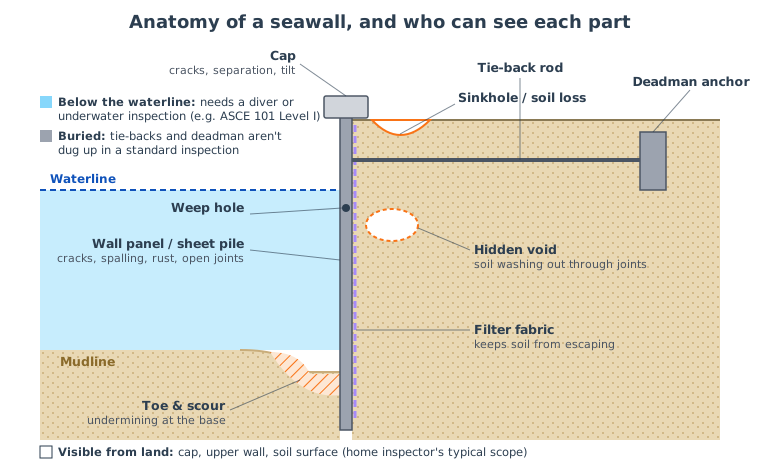
A few parts come up in every repair conversation:
- Cap: the concrete beam along the top of the wall.
- Tiebacks and deadman: rods running from the wall back into the yard, anchored to a buried block or pile.
- Toe: the base of the wall, embedded below the waterway bottom.
- Weep holes and filter fabric: openings and fabric that let water drain from behind the wall while keeping soil in.
How Seawalls Fail
Most failures come from water and soil moving where they shouldn't: through joints, under the base, or behind the wall.
Joint leaks and soil loss. Water moving through open joints carries soil with it. The ground behind the wall settles, and holes or sinkholes appear in the yard. That's what St. Pete Beach found at Pass-a-Grille.
Toe scour and undermining. Fort Lauderdale's plan describes undermining as "the result of water removing channel bottom from the toe of the seawall, allowing fill to escape from underneath the seawall." The ground behind then settles, adding stress to the whole wall.
Tieback failure. When tiebacks or their anchors fail, the wall leans, bows or develops a wavy top line. Waves can also "reduce the passive pressure upon which seawall tie backs rely," according to the same plan.
Corrosion. "Seawater contains chloride ions that can cause the reinforcing steel in seawalls to corrode," which cracks and spalls the surrounding concrete (Fort Lauderdale Seawall Master Plan). Steel sheet walls corrode directly.
Water pressure behind the wall. When weep holes clog, water builds up behind the wall and pushes on it. The extreme case came during Hurricane Ian, when Punta Gorda's canals drained ahead of the storm. With saturated soil pushing from behind and no water in front, thousands of 5,000-pound panels cracked or broke (WGCU, May 2023).
Overtopping. Storm surge can simply go over a wall. Tampa's Palmetto Beach seawall is about 5 feet high, and Helene's surge reached 7.5 feet, so rebuilding it as-is would still leave it overtopped (WMNF, April 2025).
Ice. On northern lakes, ice pushing against the shore causes its own damage. See the lake section below.
Warning Signs and When to Get an Inspection
Look over your wall a few times a year and after every major storm. Call a professional when you see lean, holes behind the wall, or rust staining.
North Carolina Sea Grant lists the signs owners can check themselves (NC Sea Grant, Coastwatch, 2024):
- holes or divots near the wall, which can signal failure below ground
- new leaning, bowing or wobbling
- severe rust
- missing pieces
- scour at the ends of the wall
- water overtopping the wall
Check lean with a level and keep dated photos so you can spot change over time. For what each symptom means and when to call someone, see which warning signs mean you need an inspection now.
How often should a professional look at the wall? There's no national rule for private seawalls. As a benchmark, Fort Lauderdale's plan recommends visual inspections of city walls every two years, and every year where walls are severely deteriorated or critical.
A standard home inspection usually covers only what's visible from land and doesn't judge structural adequacy. For a repair decision, you need a marine contractor or a professional engineer. Our complete seawall inspection guide explains what a full inspection covers and who should do it.
Seawall Repair Methods at a Glance
Most repairs target one failure mode, so matching the method to the cause matters more than the method itself. This table summarizes the main options. The durability figures are the only ones we found from an independent engineering source.
| Method | What it fixes | What it won't fix on its own | Durability (where sourced) |
|---|---|---|---|
| Spall repair or gunite | Lost concrete cover, exposed reinforcing steel | Lean, scour | "Upwards of 15 years" when done properly |
| Epoxy crack injection | Cracks that let seawater reach the steel | Cracks with efflorescence (white mineral deposits); these are routed and sealed instead | Not stated |
| Joint sealing or polyurethane injection | Soil loss through joints and small voids | Tieback failure, scour | Not independently sourced |
| Concrete jacketing | Section loss on piles or panels | Instability of the whole wall | "Upwards of 20 years" |
| Cathodic protection or metalizing | Ongoing corrosion of steel | Damage that has already happened | Metalizing can protect for decades |
| Weep hole cleaning, tidal valves, filter fabric | Water pressure and soil loss behind the wall | Structural damage | Ongoing maintenance |
| Toe and scour protection | Undermining at the base | Lean caused by tieback failure | Not stated |
| New or added tiebacks and anchors | Lean from anchor failure | Severe section loss | Engineer-designed |
| Cap replacement or raising | Cracked caps, low wall height | Damage below the cap | Raising more than about 1 foot needs a reinforced built-up cap, and may need added support piles |
Durability figures and method descriptions: City of Fort Lauderdale Seawall Master Plan, 2018, Section 4.
A few points from the same plan are worth knowing:
- Cathodic protection can mean "rehabilitating, rather than replacing, damaged structures." Its cost has dropped as contractors have gained experience with it.
- Scour protection can be as simple as sand-cement bags, concrete-filled mats, articulated concrete block, riprap (loose rock) or gabion mats. Extending the wall's footing with driven sheet piling is another option.
- Weep holes clog with rocks and oyster shells and need regular clearing. Tidal valves with replaceable filter cartridges are one way to keep them working.
Repair or Replace? The Short Version
Repair a seawall when the damage is localized and the wall still has life left. Replace it when the failure is structural, when the wall is near the end of its service life, or when local rules require a higher wall.
Remaining life is the pivot. North Carolina Sea Grant puts bulkhead life expectancy at "about 25 years, depending on their composition and location" (NC Sea Grant, 2024). A wall with decades left is worth repairing. A wall near the end usually isn't, because you'd pay for repairs and then for a new wall anyway.
Our step-by-step repair-or-replace framework walks through seven steps:
- Make sure you're deciding on a complete inspection
- Identify the failure mode
- Estimate remaining service life
- Check whether local rules will force the decision
- Understand the permit path for each option
- Compare lifecycle cost, not the first quote
- Factor in insurance, funding and who decides
You'll hear about a "50% rule." In fact, several different rules use that number: FEMA's rule for buildings, FEMA's rule for public facilities, local seawall codes, and a contractor rule of thumb. None of them is a universal test for private seawalls. The framework article untangles them.
When a wall is replaced, the new one is usually installed "immediately in front of the existing wall," according to Fort Lauderdale's plan, leaving the old wall in place. In Florida, that connects to the state's 18-inch permit allowance, covered in the permits section below.
What Seawall Repair and Replacement Cost
Seawall prices vary more than almost any other home project. They range from roughly $100 to well over $1,000 per linear foot, depending on region, wall type, access, engineering and permits. No single national figure is meaningful, so here are the sources side by side:
| Source | What it covers | Figures | Date |
|---|---|---|---|
| HomeAdvisor | New or replacement residential seawall, national | $100–$800 per linear foot for typical residential walls; $2,000+ for complex or commercial; $15,000–$60,000 total | Updated June 2026 |
| HomeAdvisor | Same, by material, per linear foot | Vinyl $200–$600; steel $250–$700; wood $150–$500; concrete $200–$800; riprap $70–$400 | Updated June 2026 |
| Fort Lauderdale Seawall Master Plan | 35 city-owned seawalls (4.41 miles), 20-year program; includes design, construction, inspection during construction, and 2% annual inflation | About $26.1 million total | February 2018 |
Why do municipal figures run so much higher than national averages? Partly because they count everything. Fort Lauderdale's estimates include structural design, land and underwater surveys, geotechnical work, permitting, and inspection during construction. They also add contingencies for restricted work areas, difficult access and mobilization (the cost of getting equipment to the site). The plan notes that "for small walls, design costs can exceed the construction cost of the wall." National averages, by contrast, don't say which costs they include or which regions they reflect.
Two practical points follow:
- A quote is only comparable to another quote for the same scope. Ask every contractor to price the same written scope, and to say whether engineering, permits and debris removal are included.
- Short walls can cost more per foot. Fort Lauderdale's plan notes that mobilization and design costs weigh more heavily on shorter walls.
Prices vary by region and site; get at least three local quotes. Our seawall replacement cost guide (publishing November 16) explains the ranges in more detail.
Permits and Local Rules
Repairs and same-place restoration often have a lighter permit path than new or relocated walls. Still, every state draws the line differently, and some South Florida jurisdictions add minimum height rules that big repairs can trigger.
Florida
State law exempts "restoration of seawalls at their previous locations or upland of, or within 18 inches waterward of, their previous locations" from state environmental permitting (Fla. Stat. § 403.813(1)(e)). The rule that implements the exemption narrows it: it applies when the wall was damaged or destroyed by a discrete event within the past year, or when the work involves only minimal backfilling and isn't primarily meant to reclaim land (F.A.C. 62-330.051(12)(b)). Coastal construction permits under Chapter 161 still apply. Using state-owned submerged land needs separate authorization.
A separate provision, § 403.813(1)(i), covers construction of small docks and seawalls in artificially created waterways. It's not a repair provision, and it excludes vertical seawalls in estuaries or lagoons.
Other states
Rules vary widely. In Connecticut, an in-kind, in-place replacement can use a general permit, while changing the wall's size or location needs an individual permit (UConn / Connecticut Sea Grant). Some lake states restrict new walls at the shoreline. Check with your state's environmental or natural resources agency.
Federal
The U.S. Army Corps of Engineers may also need to authorize the work. The 2026 Nationwide Permits took effect March 15, 2026 and expire March 15, 2031 (Federal Register, January 2026). Two are most relevant to seawalls:
- NWP 3 covers the repair, rehabilitation or replacement of a "previously authorized, currently serviceable" structure.
- NWP 13 covers bank stabilization, with limits on length and fill that can be waived through a pre-construction notification.
Your Corps district may have regional permits that apply instead.
Local height rules
Some jurisdictions now set minimum seawall heights, and a large enough repair can bring an old wall under them:
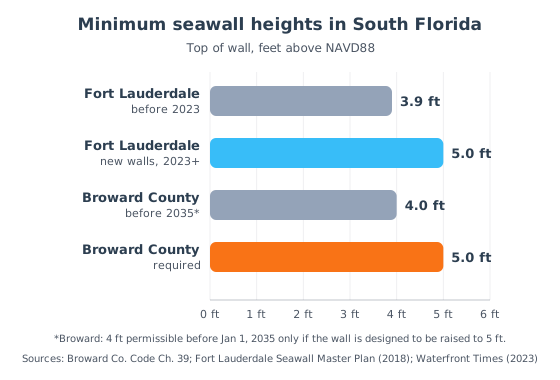
- Broward County requires 5 feet NAVD88 for new and substantially repaired walls. (NAVD88 is the national reference datum for elevation.) Until January 1, 2035, a wall may be permitted at 4 feet if it's designed so it can be raised to 5 feet by 2050 (Broward County Code, Ch. 39, Art. XXV; City of Hollywood).
- Fort Lauderdale raised its minimum for new seawalls from 3.9 feet NAVD88 to 5 feet in 2023 (Waterfront Times, April 2023).
Ask your local building department whether a minimum elevation applies and what amount of repair triggers it.
Lake and Freshwater Seawalls
Lake walls rarely face salt corrosion or large storm surge, but ice and changing water levels cause their own failures.
On northern lakes, ice is the big one. As lake ice expands, it pushes against the shore. The Minnesota Department of Natural Resources says ice action causes "significant damage to retaining walls, docks and boat lifts," and that engineering fixes "can be expensive and ineffective" (Minnesota DNR, ice ridges).
Rock riprap is a common alternative or companion to a wall on lakes. Minnesota DNR guidance calls for these specifications (Minnesota DNR, riprap):
- rock 6 to 30 inches in size
- a filter layer of crushed rock, gravel or fabric underneath
- a slope no steeper than 3:1
It also notes that riprap "does not eliminate ice heaving."
Wave exposure matters on any water body. Fort Lauderdale's engineers point out that the forces on a wall depend on fetch (how far wind can blow across open water) and on the wall's orientation. A wall facing a long stretch of open lake can take more punishment than a canal wall.
Many lake states also regulate new walls at the shoreline and favor alternatives such as riprap or vegetation. Check with your state natural resources agency before replacing or adding a lake wall.
Insurance, Storms and Funding
Standard federal flood insurance won't pay for the wall. The NFIP's Standard Flood Insurance Policy excludes "fences, retaining walls, seawalls, bulkheads, wharves, piers, bridges, and docks" (44 CFR Part 61, Appendix A(1)). If you have private flood or homeowners coverage, read the policy terms for seawalls before assuming either way.
Storm damage can be widespread. After Ian, Punta Gorda reported more than 6.5 miles of damaged seawall in Punta Gorda Isles and about three-quarters of a mile in Burnt Store Isles, affecting roughly 582 parcels (CHNEP Water Atlas, February 2023). Disaster programs may help pay for public and city-maintained seawalls. Private owners generally shouldn't count on that money.
After a storm, document the damage with dated photos before any cleanup. Keep people and equipment back from walls that are leaning or have holes behind them. Get a professional assessment before temporary fixes turn into permanent ones.
HOAs, Condos and Shared Walls
When a wall is shared, the community's governing documents decide who owns it, who pays and who decides. A board needs the same engineering basis as an individual owner, plus a paper trail. Good practice:
- Confirm ownership. Check the declaration, the plat and property records to see whether the wall belongs to the association or to individual lots.
- Plan reserves. A seawall is a large, predictable expense. Use the engineer's remaining-life estimate to plan reserves, so replacement doesn't arrive as a surprise special assessment.
- Get a second opinion before committing to a major repair or a replacement.
- Bid one scope. Send every contractor the same written scope so the quotes are comparable.
- Communicate. Share the inspection findings, the options considered and the reasons for the decision with owners.
- Watch the deadlines. In Broward County, owners cited for tidal flooding through or over their wall must show progress within 60 days and finish within 365 days (City of Hollywood), so a board can't let the decision drift.
Getting Started: Choosing a Seawall Contractor
- Get a complete inspection, above water, below water and behind the wall, with condition ratings and a remaining-life estimate.
- Turn the findings into a written scope.
- Get at least three quotes for that same scope from licensed marine contractors.
- Verify licenses and insurance. In Florida, you can check a contractor's license on the state's licensing portal.
- Put permit responsibility in the contract: who applies, who pays the fees, and what happens if a permit is delayed or denied.
When you're ready, find seawall contractors near you.
Frequently Asked Questions
How long does a seawall last?
NC Sea Grant puts bulkhead life expectancy at about 25 years, depending on composition and location. Actual life varies with material, exposure and maintenance. Ask your engineer for a remaining-life estimate for your wall.
Can a leaning seawall be repaired?
Sometimes. If the panels are sound and the lean comes from failed tiebacks or anchors, new anchors can sometimes stabilize the wall. A leaning wall needs a professional engineer's assessment before anyone chooses a fix.
How much does seawall repair cost per foot?
There's no single number. HomeAdvisor (updated June 2026) lists about $100 to $800 per linear foot for typical residential seawalls, and engineered projects in places like South Florida can run much higher. See the cost table above, and get at least three quotes for the same scope.
Do I need a permit to repair a seawall?
Usually you need some approval. In Florida, restoring a seawall in place may be exempt from state environmental permitting under § 403.813(1)(e) if its conditions are met. Local building permits and federal authorization may still apply. Check with your state agency and your local building department.
Does insurance cover seawall damage?
Not under a standard NFIP flood policy, which excludes seawalls and bulkheads. Check any private policy's terms.
The Bottom Line
- Catch small problems early. Cracks, open joints and clogged weep holes are cheaper to fix than the failures they lead to.
- Match the repair method to the cause of the damage.
- Decide repair vs replace on remaining life and lifecycle cost, using a complete inspection.
- Check permits and local height rules before you sign a contract.
- Compare quotes only when they price the same scope.
Ready to get started? Find licensed seawall contractors, compare their services, and contact them directly.
This guide is general information, not engineering or legal advice. For structural decisions, consult a licensed professional engineer and follow your local building department's requirements.